
Dickinson State University Welcomes Dr. Talha Naqash, Cybersecurity and AI Expert
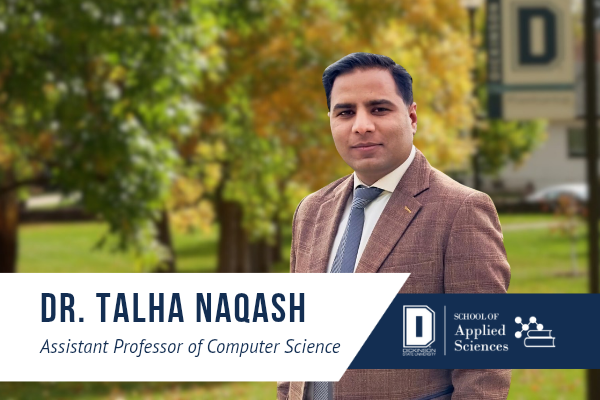
Dickinson State University welcomed Dr. Talha Naqash to its faculty this fall, adding expertise in cybersecurity, artificial intelligence, secure computing systems and the ethical implications of emerging technologies.
Naqash joins DSU as an assistant professor of computer science and is working alongside Dr. Omi Miah, assistant professor of computer science, to design curriculum for the university’s new Bachelor of Science in Cybersecurity and Artificial Intelligence, scheduled to launch in fall 2026. The degree program supports DSU’s efforts to expand high-demand offerings in computer science and applied sciences to meet regional workforce needs.
“Dr. Naqash brings a rare combination of technical expertise and a strong commitment to ethical and student-centered education,” said Dr. Liz Freedman Fowler, dean of the School of Applied Sciences. “His background in cybersecurity and artificial intelligence strengthens our academic programs and ensures our students are prepared to address real-world challenges in a rapidly evolving digital landscape.”
Naqash brings a multidisciplinary academic background in mathematics and computer science. He earned a master’s degree in telecommunication and networking, where he focused on communication systems and security fundamentals. He later completed a doctorate in engineering education at Utah State University, with research centered on cognitive science and its role in STEM learning.
Before joining DSU, Naqash served as a faculty member at Bahria University, where he worked in curriculum development and applied research with an emphasis on real-world application.
Research and impact
Naqash’s research focuses on the design and deployment of secure, trustworthy and ethically responsible computing systems in an era shaped by artificial intelligence and widespread digital connectivity. His work addresses risks associated with cyberattacks, data misuse and insecure system design across sectors such as banking and health care.
His research explores emerging cybersecurity challenges, including AI-driven attacks, zero-trust security models and data privacy concerns. Naqash examines how defensive systems can responsibly incorporate AI without increasing risk, emphasizing secure design principles and continuous system verification.
He advocates for proactive approaches to cybersecurity, stressing that ethical and secure systems must be built from the outset rather than addressed after failures occur.
Vision for DSU
“I was drawn to Dickinson State University because of its emphasis on teaching excellence, student engagement and its commitment to serving regional and workforce needs,” Naqash said.
At DSU, he is developing courses in applied cybersecurity, AI security and AI ethics, with a focus on hands-on learning and practical application. Course topics will include secure system design, AI-enabled threat detection and ethical hacking practices. He also plans to contribute to future certificate programs that integrate cybersecurity and AI for both traditional students and working professionals.
Naqash said education plays a critical role in preparing future professionals to understand not only how to use advanced technologies, but also when and why to evaluate their ethical and societal impacts.
Background and personal insight
Naqash’s interest in cybersecurity developed alongside the rapid expansion of digital technologies and growing awareness of risks tied to poor system design. He views cybersecurity as a shared societal responsibility rather than a purely technical challenge.
Outside the classroom, Naqash mentors students on career development and ethical decision-making. He also studies technology policy, AI governance and the broader societal effects of emerging technologies, which inform his teaching approach.
University officials said DSU’s continued focus on cybersecurity, artificial intelligence and emerging technologies supports its strategic priorities in technology education and workforce preparation, positioning graduates to address complex challenges in an evolving digital landscape.