
DSU Student Eniola Soetan Reflects on the Meaning of Black History Month
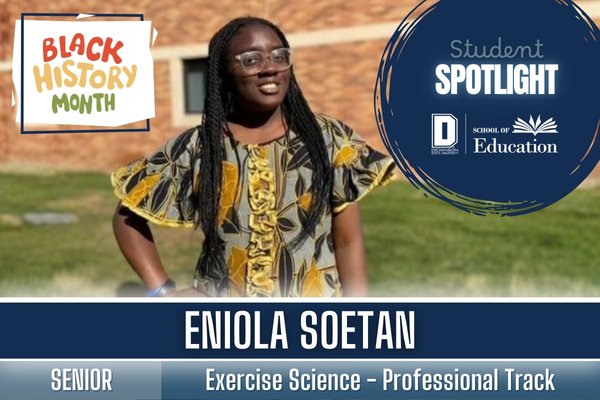
For Black History Month, Dickinson State University student Eniola Soetan shares what the month means to her and reflects on her journey, inspirations and cultural identity.
Q: Can you tell us a little about yourself and your journey at Dickinson State University?
A: My name is Eniola Soetan. I’m a senior at Dickinson State, majoring in exercise science (professional track) and minoring in coaching and biology. I was born in Lagos, Nigeria, which is where my name and much of my culture come from. Eniola means “person of wealth, honor and prosperity” in Yoruba, which is the tribe I’m from and one of the languages I speak.
I spent the first two years of my life in Nigeria, then moved to the United Kingdom for a short time before living most of my life in Winnipeg, Canada. I transferred to Dickinson State about three years ago. I was on the women’s basketball team for a while but was sidelined by knee injuries. Since then, I’ve been able to get involved in many other areas on campus, including Student Ambassadors, Student Senate, Campus Activities Board, Pacesetters, Blue Hawk Connections and starting the Girls4Sports club. I still love showing up to games to support our Blue Hawks.
Outside of school, I enjoy reading, creative writing, being outdoors, watching sports and spending time with people I care about.
Q: What has been your biggest inspiration in life, and why?
A: That’s a hard question to answer. I draw inspiration from almost everyone I meet. Hearing about people’s unique journeys and seeing how they pursue their dreams really inspires me. I’ve been moved by people’s resilience, their work-life balance, how they care for others, their patience and how they defy the odds.
It’s hard to pick just one person or thing, but I’ve been fortunate to be surrounded by a lot of incredible people throughout my life. If I’ve had a meaningful interaction with you, there’s a good chance you’ve inspired me in some way.
Q: Who has served as a role model in your life?
A: Many people have served as role models in my life. As I’ve grown older, I’ve come to understand the sacrifice it takes to move to an entirely different country — multiple times — and raise a family in an environment you’re still learning to navigate. My parents, and especially my dad, are huge role models for me.
Watching my dad complete his doctoral program after my mom passed away, while continuing his research and being there for me and my brother, is something I still can’t fully wrap my head around. He showed me that those things are possible with hard work and support. My entire family inspires me because of the sacrifices and struggles they’ve endured to get where they are today.
I’ve also had many mentors and friends pursuing amazing things in athletics, education, research and community service, and I look up to them as well.
Q: What does Black History Month mean to you personally?
A: For me, Black History Month is about reflecting on stories of hope and resilience in the face of struggle and adversity. It’s a time to intentionally recognize the contributions made possible by that resilience and to continue educating myself on those stories.
It’s humbling to think about where I would be without those contributions. Black History Month connects me to those stories and reminds me how much I owe my opportunities today to the actions of people who came before me.
Q: How can students and alumni honor and celebrate Black History Month?
A: A great way to honor Black History Month is by taking time to learn about the history and contributions that come from it. There are powerful and inspiring stories that can have a real impact, and sometimes those stories are closer to us than we realize.
Even though it’s a month focused on Black history, there are many ways people can connect to and be inspired by that history today and in the future. Personally, I’m inspired by figures such as Mary Jackson, Katherine Johnson and Dorothy Vaughan — NASA’s “Hidden Figures” — as well as Jackie Robinson, Bill Russell, Fritz Pollard, Alice Coachman, Dr. Rebecca Lee Crumpler and Dr. James McCune Smith.
Q: Can you share a personal story or experience that shaped your understanding of Black history or culture?
A: In high school, I was part of a Black History Month committee that planned events throughout the month and a culminating event. I learned so much about Black history and about other people’s experiences. Those were powerful moments I wouldn’t have experienced if I hadn’t been involved.
One of my biggest takeaways was realizing that Black history isn’t static. Even though we often talk about it as something in the past, it’s fluid and ongoing. Learning about others’ experiences helps us better understand ourselves, our communities and our futures.
Q: Is there anything else you would like to share?
A: There is no single “right” way to acknowledge or celebrate Black History Month. There’s space for expression through writing, speaking, poetry, visual art, music and dance, and there’s also space for listening and reflection. Black History Month is for everyone, and experiencing it in different ways is part of its beauty.