
DSU Partners with Smithsonian National Zoo on Historic Trail Research
In celebration of the United States of America’s 250th anniversary, students from Dickinson State University’s (DSU) School of Applied Sciences (SoAS) are gaining real‑world research experience through a unique partnership with the Smithsonian National Zoo, contributing to a nationwide effort to document wildlife along the historic Lewis and Clark Trail. Following in the footsteps of these famous explorers, a new generation is re-surveying the trail to study changes in wildlife across America.
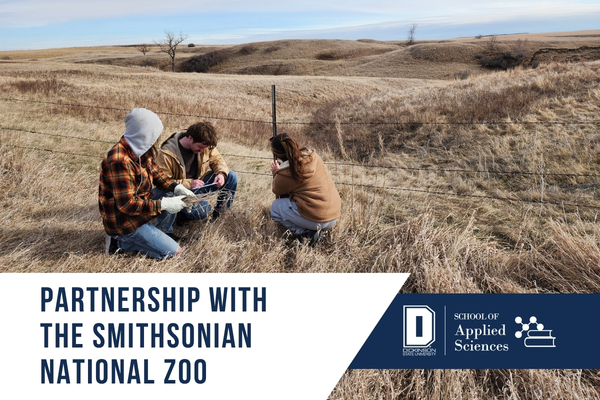
Under the guidance of Dr. Sarah Manka, Shawna Egli, and Dr. Colin Strine, DSU Environmental Science and Biology students collaborated with Smithsonian scientist Brigit Rooney and private landowners to deploy trail cameras at selected sites along the Lewis and Clark trail. The project involved hands‑on training in camera placement, positioning, technical settings, and interpreting environmental clues that indicate animal activity. Students Miranda DiBenedetto, Wesley Isaac, and Kaleb Hamann were onsite deploying the trail cameras at the end of March, applying classroom knowledge in a field‑based research setting.
After observing and assisting with the installation of the first cameras, each student took the lead in setting up the remaining units. This approach emphasized technical and leadership skill development, allowing students to practice decision‑making and problem‑solving in authentic research conditions.
“These experiences reflect the kind of learning that prepares students for scientific careers,” said Dr. Manka. “Students are not just collecting data. They are learning how to design research, work as part of a professional team, and adapt to real‑world challenges of fieldwork. We’ll see how the retrieval goes, as we might find out how fast thorny bushes grow in North Dakota.”
The collaboration highlights DSU’s commitment to active, experiential learning. Throughout the partnership, students will have participated in every stage of the research process, from experimental design and field deployment to data collection and analysis. By working alongside Smithsonian professionals and new collaborators, students gained insight into how large‑scale scientific projects operate across institutions.
Later this spring, DSU students and faculty will return to the sites to reposition the cameras for a new phase of data collection. Once images are captured, the photographs must be processed. While the Smithsonian is partnering with Wildlife Instincts to handle data management, DSU students and faculty will carefully review each photograph to confirm animal presence and species identification.
This detailed analysis is particularly valuable for students like DiBenedetto and Hamann, who are collecting trail camera data for their own independent undergraduate research projects. The opportunity provides direct experience with skills essential for careers in environmental science and ecology such as data verification and wildlife identification.
The DSU and Smithsonian collaboration is part of a larger national initiative tied to America’s upcoming 250th anniversary. The Lewis and Clark Trail Resurvey project seeks to document the wildlife species that still roam freely along the historic expedition route. Cameras are being installed across the entire length of the trail throughout 2026, bringing together public institutions, private organizations, and community scientists to create a comprehensive photographic record of North American wildlife.
For DSU students, participation in this project represents more than a research opportunity – it is a chance to contribute to a nationally significant scientific effort while building skills that will serve them well beyond the classroom.