
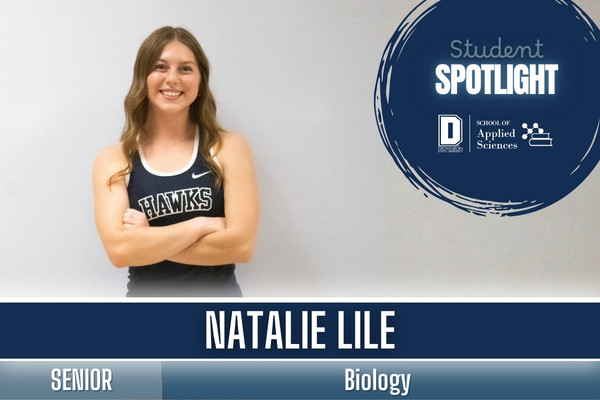
For some, handwashing is a mindless five-second habit. For Dickinson State University (DSU) senior and Biology major Natalie Lile, it is a lifelong fascination rooted in family history and scientific curiosity. From growing up in a household of healthcare workers to working as a phlebotomist at CHI St. Alexius, she has always understood that the smallest microbes can have the biggest impact.
The spark for biology started in middle school, and the decision to call DSU home clicked during a high school visit. "The start of every class with our science professor would begin with him saying, ‘The human body is truly amazing!’" Lile recalls. That enthusiasm, combined with a desire to understand an ever-changing world, set the stage for a four-year journey into the microscopic.
The Research: Soap, Swabs, and 137 Volunteers
Under the mentorship of DSU Biology faculty Dr. Colin Strine, who emphasizes evidence-based precision in his research classes, Lile launched a massive research project to evaluate how different soaps and sampling methods affect bacterial reduction.
The scale was ambitious: 137 volunteers and 274 hand-poured petri dishes, each requiring hours of preparation, care, and analysis.
The process was hands-on—literally. Lile swabbed the palms of volunteers, and they pressed their fingertips onto agar plates (Petri dishes) to collect the bacteria lurking on their hands. Then, volunteers washed their hands using World Health Organization’s standardized washing procedure and one of a variety of soaps. The palm swab and fingertip sampling were repeated on a second Petri dish to see how many bacteria remained.
Next, the samples were incubated at 37 degrees Celsius (body temperature) to watch the bacterial colonies grow large enough to see. "Looking at the colors, shapes, and textures of the different bacterial colonies never got old," Lile said, enjoying the laborious task of counting every single colony by hand.
The goal isn’t just to crunch numbers; it’s to change habits. By quantifying which soaps actually kill the most germs, this research aims to "plant a seed" in the minds of the DSU community. "I find myself thinking about the duration of scrubbing and the amount of soap more than normal," Lile admits. "I could perform the procedure in my sleep now!"
The success of her project depended on extensive planning and an outpouring of volunteers from the DSU community. “This is a super cool project that has had the participation of folks across campus,” said Dr. Strine. “I have seen her running participants through the microbiology lab at all hours of the day. What I love about Natalie’s project is that she created a practice data set prior to collecting the real data, so that no matter what results the project bore, she knew the best methods to analyze that bacterial growth.”
While the data is still being finalized, the campus community won’t have to wait long for the results. You can catch the full presentation at DSU’s Celebration of Scholars on Saturday, April 25th.
As for life after the cap and gown? The future looks bright—and busy. Lile will continue her work as a phlebotomist before applying to Physician Assistant school this summer. Her ultimate goal is to return home to Montana to serve a rural community.
Natalie’s parting advice for freshman? "The hardest part about school is simply showing up for class, but your future self will thank you for it. Rely on the faculty; they truly want us all to succeed."